

Why Your Strategy is Stalling and How to Fix It: Escaping Pilot Purgatory
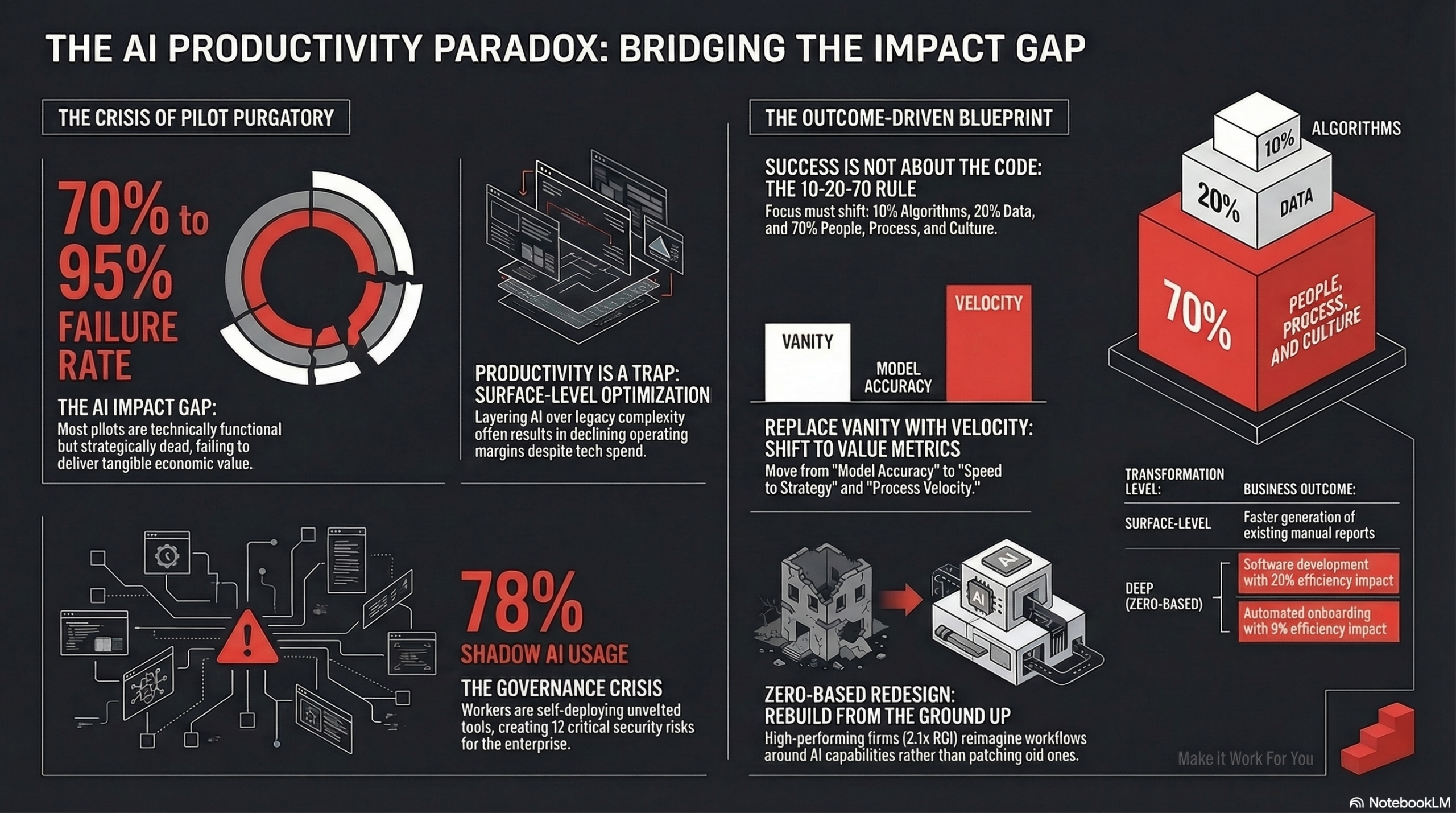
The global C-suite is currently reeling from an economic indictment: despite AI being a top strategic priority for 75% of executives, the “AI Impact Gap” remains a yawning chasm. The statistical reality is sobering, with 70% to 95% of AI pilots failing to deliver tangible economic value. Organizations are pouring billions into Large Language Models (LLMs), yet most find themselves trapped in “Pilot Purgatory”—a state of perpetual experimentation where initiatives are technically functional but strategically dead.This failure is rarely a result of poor code; it is a failure of structural discipline. For many leaders, a pilot is deemed a “success” if the algorithm performs, but without a clear connection to an EBITDA-positive outcome, these projects inevitably stall. To transition from potential to profit, executives must move beyond “vibe coding” and fragmented demos to treat AI as a fundamental organizational rewiring.
Takeaway #1: The 10-20-70 Rule (It’s Not About the Code)
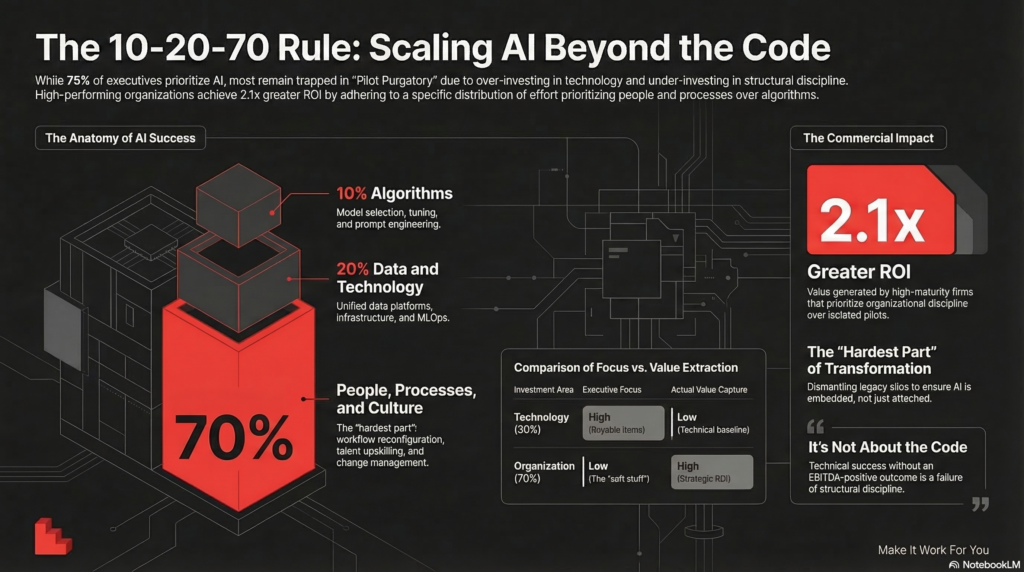
Executive focus is often inversely proportional to value creation. Leaders instinctively gravitate toward the 10% or 20% of the AI stack because they are “buyable” line items. However, high-performing organizations—those generating 2.1 times greater ROI than their peers—recognize that the software is only a fraction of the solution. Success follows a rigid distribution of effort:
70% People, Processes, and Culture: Workflow reconfiguration, talent upskilling, and change management.”The ‘70%’ represents the most significant investment but captures the most value. Organizations that ignore this ratio and focus purely on technical development often find themselves with sophisticated models that no one uses.” — Outcome-Driven AIIn high-maturity firms, the 70% is not “soft stuff”—it is the hardest part of the transformation. It involves dismantling legacy silos and redefining the very nature of work to ensure AI is embedded, not just attached.
10% Algorithms: Model selection, tuning, and prompt engineering.
20% Data and Technology: Unified data platforms, infrastructure, and MLOps.
70% People, Processes, and Culture: Workflow reconfiguration, talent upskilling, and change management.”The ‘70%’ represents the most significant investment but captures the most value. Organizations that ignore this ratio and focus purely on technical development often find themselves with sophisticated models that no one uses.” — Outcome-Driven AIIn high-maturity firms, the 70% is not “soft stuff”—it is the hardest part of the transformation. It involves dismantling legacy silos and redefining the very nature of work to ensure AI is embedded, not just attached.
Takeaway #2: Productivity is a Trap—Reimagination is the Goal
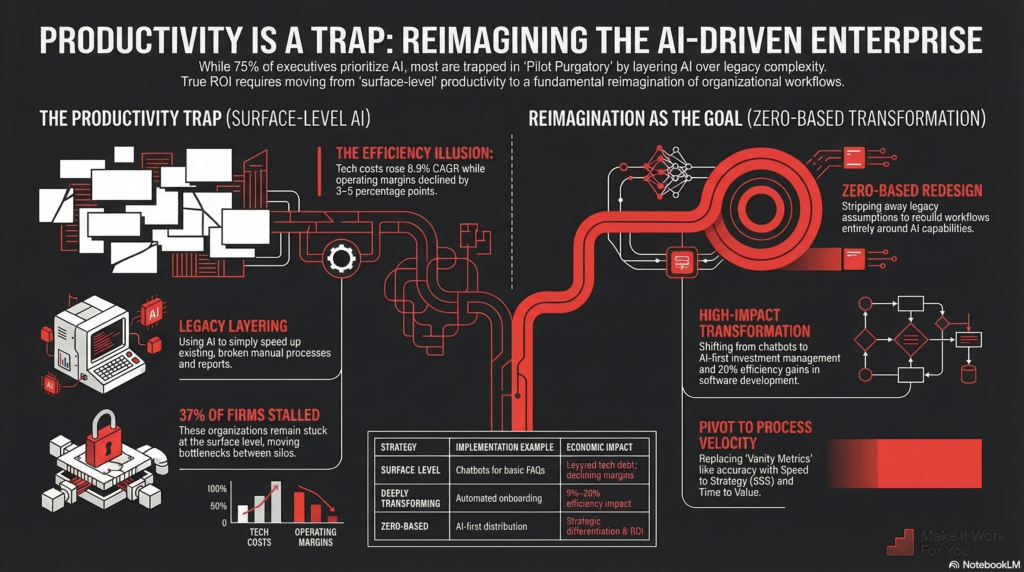
Many firms use AI to optimize existing, broken processes. This “surface-level” approach is a primary driver of ROI failure. In the asset management sector, McKinsey research reveals that technology costs have grown at an 8.9% CAGR , yet pre-tax operating margins have declined by 3 to 5 percentage points . Spending more on tech has not consistently translated into higher productivity because firms are layering AI over legacy complexity.To break this cycle, leaders must adopt a “Zero-Based Redesign,” stripping away legacy assumptions to rebuild workflows around AI capabilities. Only 34% of companies are truly reimagining their business, while 37% remain stuck at the surface level.| Surface-Level AI | Deeply Transforming AI (Zero-Based) || —— | —— || Faster generation of existing, manual reports | Automated onboarding with 9% efficiency impact || Using chatbots for basic customer FAQs | Software development with 20% efficiency impact || Layering AI on legacy tech debt | AI-first investment management & distribution || Moving the bottleneck to a different silo | Strategic differentiation and competitive edge |
Takeaway #3: The Shadow AI Crisis (78% of Your Team is Already Using It)
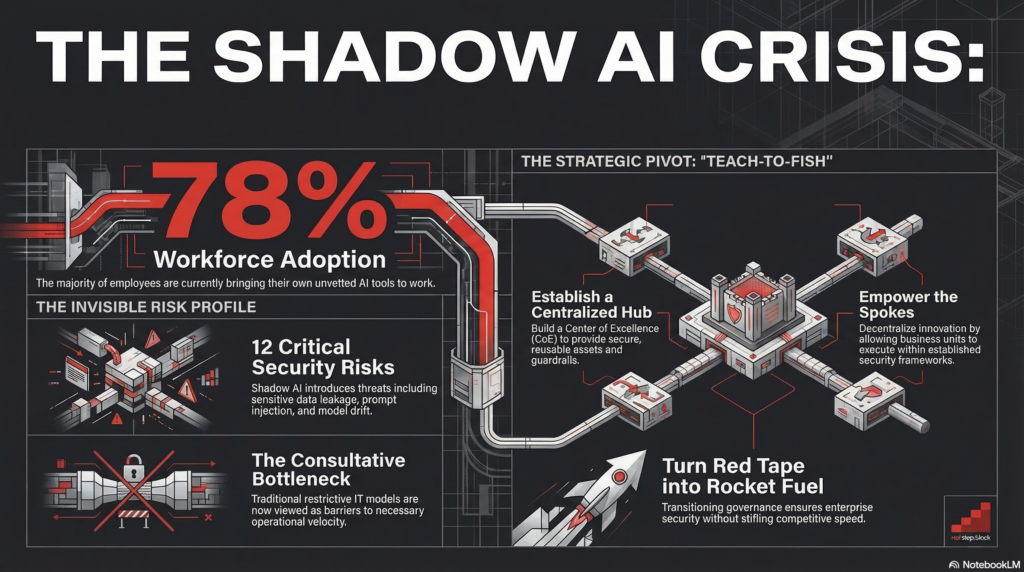
While leadership deliberates over frameworks, the workforce has already self-deployed. This creates a strategic crisis of “Shadow AI” that bypasses corporate governance.Warning: 78% of workers are currently bringing their own unvetted AI tools to work.This behavior introduces 12 critical security risks, including prompt injection, sensitive data leakage, subversion of internal governance, and model integrity/drift. To turn this “red tape into rocket fuel,” CIOs must transition from restrictive “Consultative Models”—which the industry increasingly views as a bottleneck—to a “Teach-to-Fish” Governance Model .Under this model, a Centralized Hub (CoE) provides secure, reusable assets and guardrails, while empowering the “spokes” (business units) to innovate. This ensures security without stifling the velocity required to maintain a competitive advantage.
Takeaway #4: AI Agents Need an “HR Department”
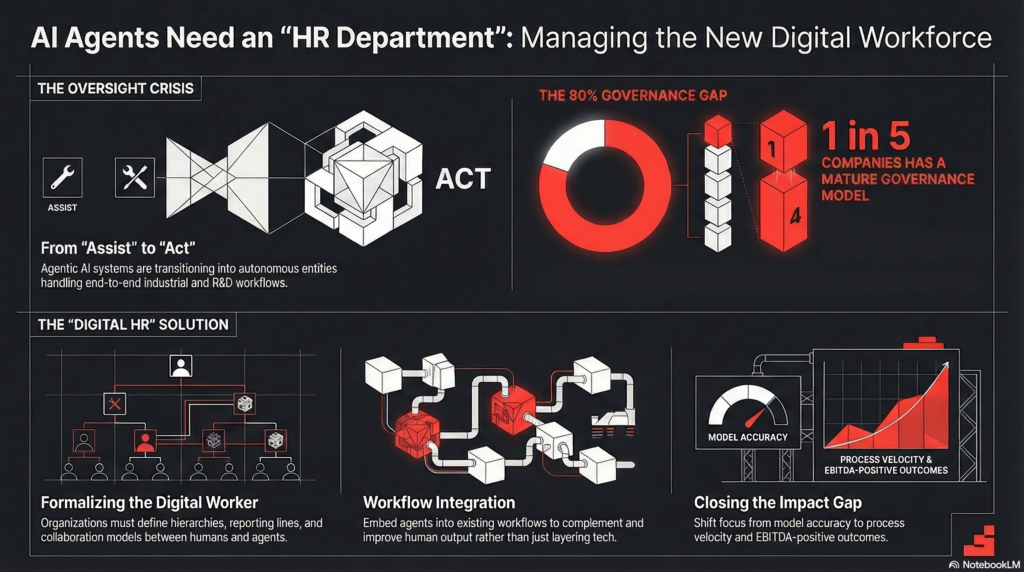
The industry is moving from tools that assist to “Agentic AI”—autonomous systems that act . As AI agents begin to handle end-to-end workflows in supply chain management and R&D, they must be treated as a new class of “digital worker.”This shift is sociological: AI agents require their own “HR Department” to define hierarchies, reporting lines, and collaboration models with human counterparts. While agentic usage is set to surge—reaching 80% for physical AI in some regions like Asia Pacific—oversight is lagging dangerously behind.The Oversight Gap: Only one in five companies currently has a mature model for the governance of autonomous AI agents.”2025 could mark a turning point for adoption… Companies must embed these agents into workflows so that they complement and improve the work of humans.” — BCG AI Radar: From Potential to Profit
Takeaway #5: The New KPIs—From Vanity Metrics to “Process Velocity”
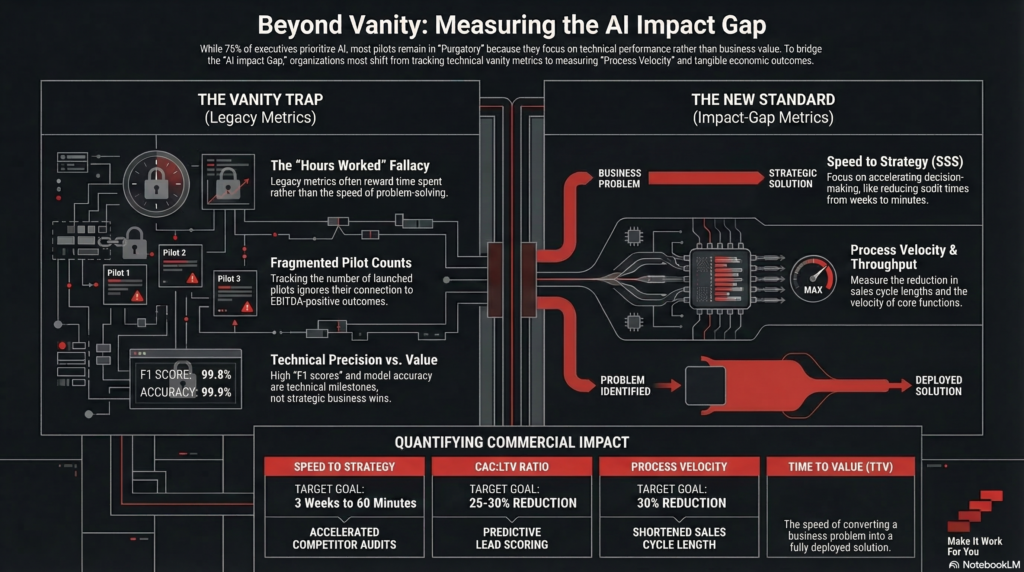
Traditional technical metrics such as “F1 scores” or “Accuracy” are Vanity Metrics in the C-suite. They obscure business reality and fail to quantify EBITDA expansion. To bridge the impact gap, leaders must pivot to outcome-oriented KPIs that measure organizational agility.
Legacy (Vanity) Metrics:
Model Accuracy & Precision
Number of Pilots Launched
Hours Worked (The “Hours Worked Fallacy”)
Impact-Gap (Value) Metrics:
Speed to Strategy (SSS): Reducing a deep competitor audit from 3 weeks to 60 minutes .
Process Velocity: Throughput of core functions (e.g., a 30% reduction in sales cycle length).
Time to Value (TTV): The velocity of converting a business problem into a deployed solution.
CAC:LTV Ratio: Using AI to reduce Customer Acquisition Cost by 25-30% through predictive scoring.
Conclusion: The 2027 Divide
By 2027, a clear divide will emerge between the winners and the laggards of the AI era. The distinction will not be the specific LLM they purchased, but the organizational discipline they applied. Winners will have moved beyond isolated pilots to build industrialized “AI factories” governed by hub-and-spoke models and measured by process velocity.As you evaluate your current trajectory, ask yourself:
Is your organization merely layering AI onto legacy processes to hide inefficiency, or are you brave enough to rebuild your business from the ground up?