

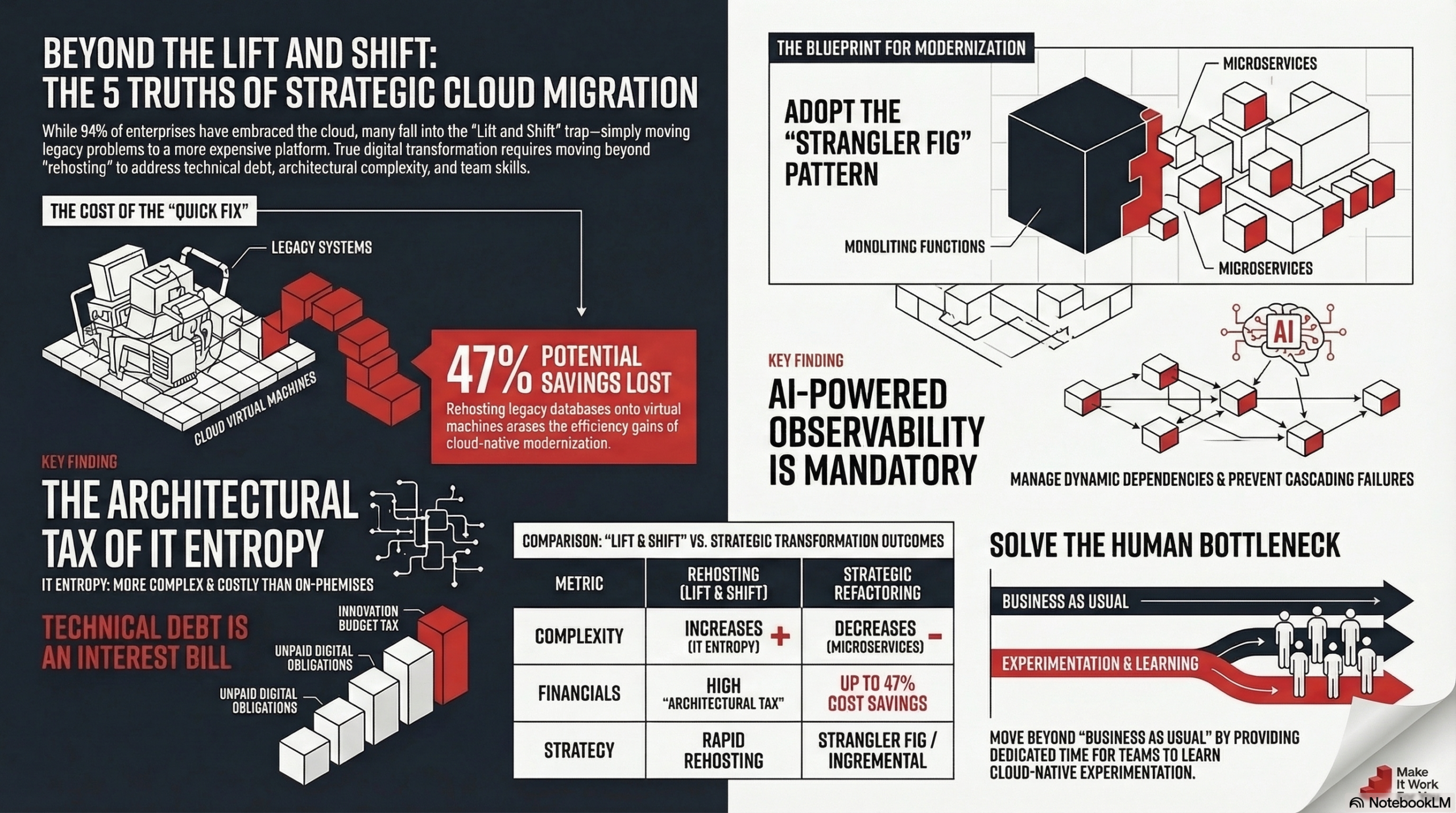
5 Counter-Intuitive Truths About Modern Cloud Migration
The pressure to migrate is no longer just about IT efficiency; it is a matter of survival. Recent data indicates that 94% of enterprises have already embraced cloud services, and global spending on digital transformation is projected to hit $1.8 trillion this year. Driven by the need to navigate supply chain disruptions and volatile customer expectations, 67% of organizations have accelerated their digital journeys.However, after decades in this industry, I have seen a recurring failure: leaders assume that moving to the cloud is the same as transforming in the cloud. They prioritize the “quick fix” over operational excellence, only to find that their move has actually decreased their agility while increasing their costs. To avoid this, stakeholders must understand these five counter-intuitive truths.
Truth #1: Your “Quick” Migration is Actually an Architectural Tax
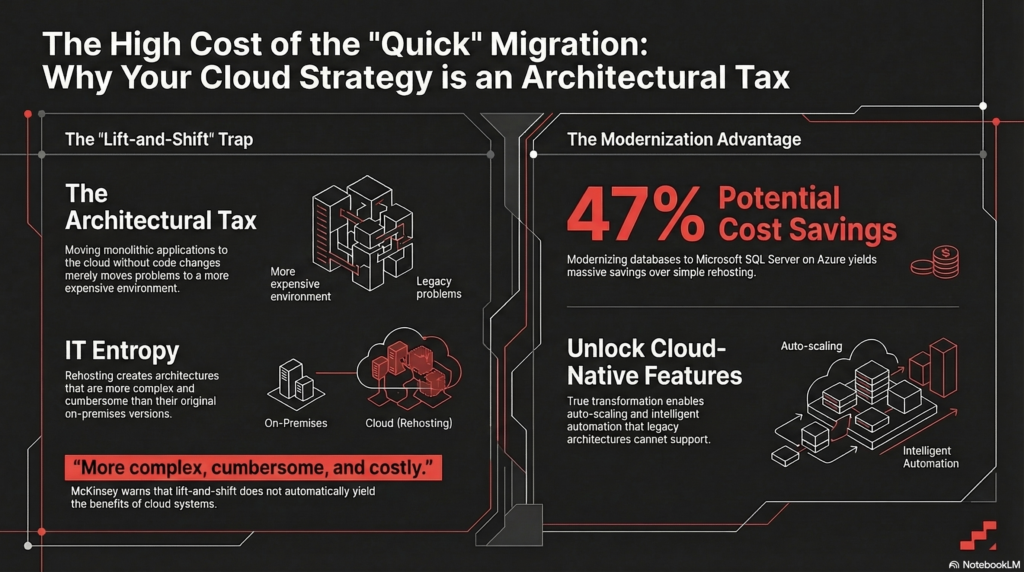
The most common trap is rehosting, or “lift-and-shift.” On paper, it looks like a win—you move a monolithic application to cloud hardware with zero code changes. In reality, you are simply moving your problems to a more expensive neighborhood. Because these legacy systems were architected for a bygone infrastructure era, they are incapable of leveraging cloud-native features like auto-scaling or intelligent automation.We have observed that rehosting legacy architecture is a recipe for “IT entropy”—creating systems more cumbersome and complex than their on-premises ancestors. While modernizing a database to Microsoft SQL Server on Azure can yield up to a 47% saving, those gains are entirely lost if the system is simply “dumped” onto a virtual machine without a transformational strategy.”Just taking legacy applications and moving them to the cloud – ‘lift-and-shift’ – will not automatically yield the benefits that cloud infrastructure and systems can provide. In fact, in some cases, that approach can result in IT architectures that are more complex, cumbersome, and costly than before.” — McKinsey
Truth #2: Technical Debt is an Unpaid Interest Bill on Innovation
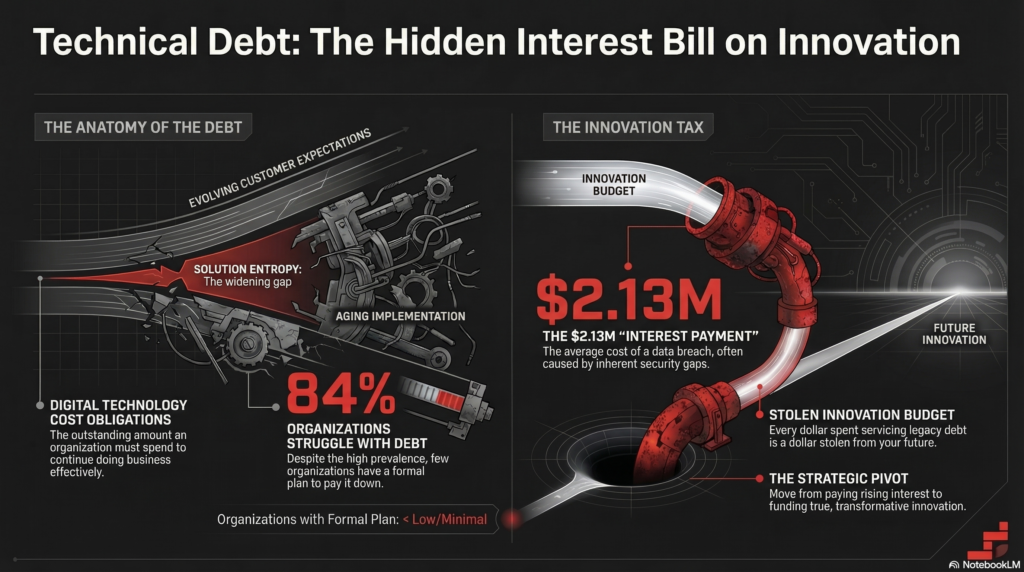
Technical debt is often dismissed as a “developer problem.” It isn’t. It is a material cost to the business that remains hidden from the balance sheet. Gartner defines it as the “outstanding amount of money an organization must spend on digital technology cost obligations to continue doing business.” While 84% of organizations struggle with this debt, few have a formal plan to pay it down.Crucially, technical debt is driven by “solution entropy.” This is the gap created by time; as customer needs evolve and technology advances, your existing implementation becomes increasingly misaligned with “what good looks like.” This misalignment doesn’t just slow you down—it creates risk. For example, the average cost of an Australian data breach is now $2.13M, a high “interest payment” often caused by the security gaps inherent in aging systems. Every pound you spend servicing this debt is a pound stolen from your innovation budget.
Truth #3: The “Strangler Fig” is the Safest Path to Speed
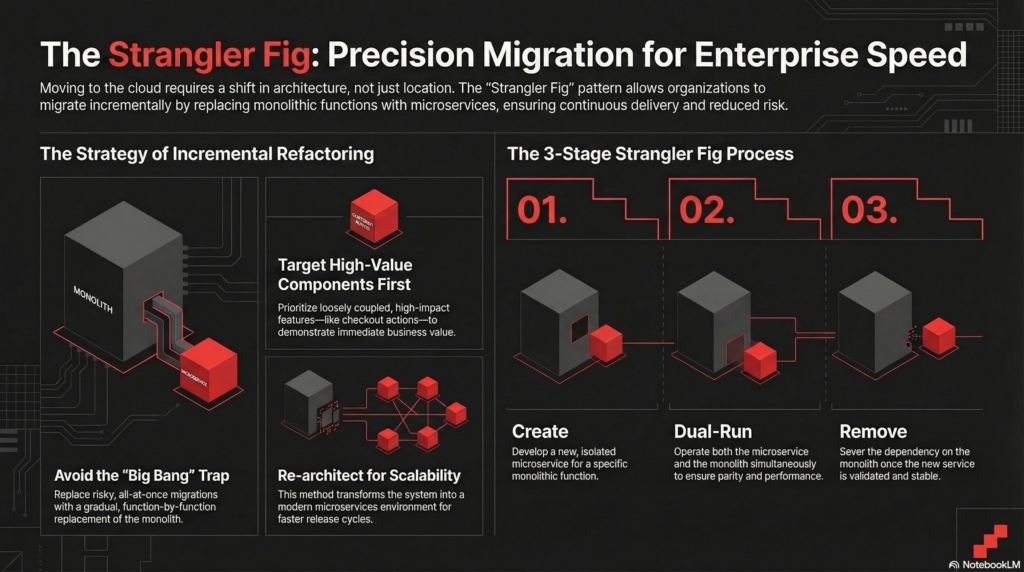
If a “big bang” migration is too risky and a lift-and-shift is too costly, the solution is Incremental Refactoring . We utilize the “Strangler Fig” pattern, a method where you gradually replace monolithic functions with microservices until the old system is eventually retired.Successful strategists don’t try to rebuild Rome in a day. Instead, they identify “loosely coupled” components with high business value—such as a webpage checkout action—and migrate them first. This process follows three disciplined stages:
Create a new microservice for the specific function.
Dual-run both the microservice and the monolith to ensure parity.
Remove the dependency on the monolith once testing is successful.This approach acknowledges that refactoring is actually “re-architecting,” requiring a long-term commitment to achieve true scalability and faster release cycles.
Truth #4: AI-Powered Observability is the Only Way to See
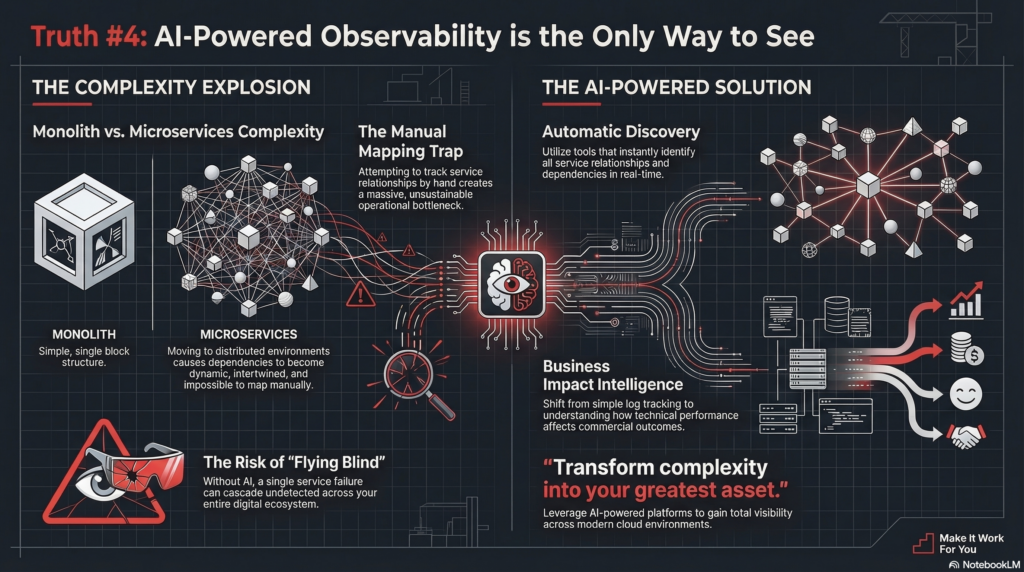
As you move from a single monolith to a distributed microservices environment, complexity does not just increase; it explodes. In these modern systems, dependencies are dynamic and intertwined. Attempting to map these relationships manually is a fool’s errand that creates a massive operational bottleneck.To succeed, organizations must move beyond simple log tracking and adopt AI-powered observability. This requires automatic discovery tools that understand service relationships and their business impact in real-time. Without this, you are flying blind in an environment where a single service failure can cascade across your entire ecosystem.”See how our AI-powered observability platform transforms complexity into your greatest asset.” — Dynatrace
Truth #5: Your BAU Team is Your Migration’s Biggest Risk
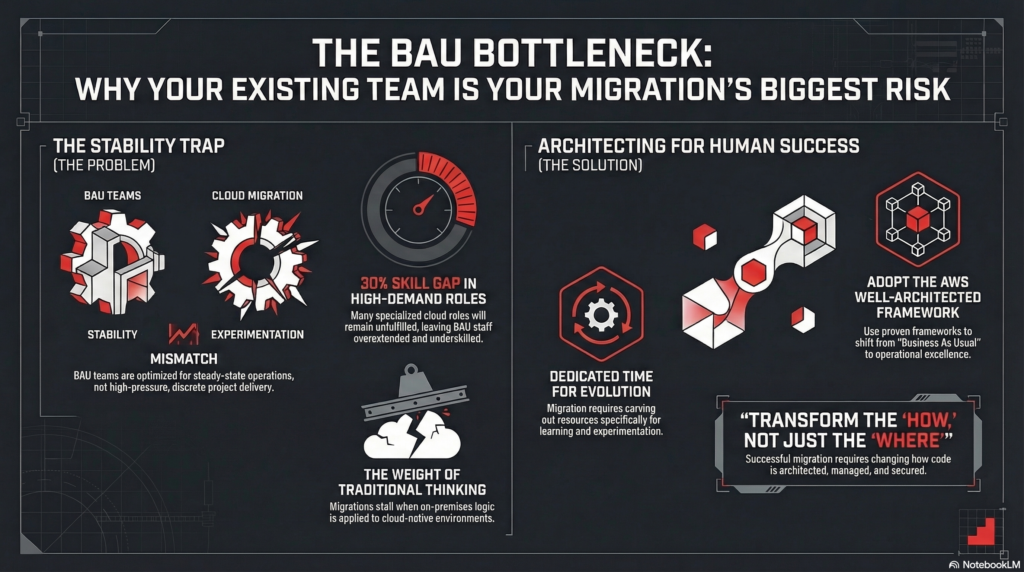
While AI-powered observability can solve technical complexity, it cannot solve the most persistent hurdle of all: the human element. The skills required to manage on-premises workloads do not translate directly to the cloud. IDC predicts that 30% of high-demand roles for emerging technologies will remain unfulfilled through 2022.The mistake most leaders make is tasking their “Business As Usual” (BAU) staff with the intense pressure of a cloud transition. These teams are often optimized for stability, not the discrete project delivery and “fail-fast” experimentation required for a migration. Achieving operational excellence, as outlined in the AWS Well-Architected Framework, requires dedicated time for learning and a culture of experimentation. If you do not provide your people with the resources and time to evolve, your migration will stall under the weight of traditional thinking.
Conclusion: Getting Your House in Order
Successful cloud migration is not merely a change in “where” your code lives; it is a fundamental shift in “how” that code is architected, managed, and secured. Moving a monolith to the cloud without a transformational strategy only migrates your problems to a platform that will charge you more for them.As you evaluate your current roadmap, I leave you with one strategic question:
Is your organization spending its budget on true innovation, or are you simply paying the rising interest on your technical debt?